Table of contents
- 10 indicators for choosing a cat hotel without regrets
- What is a “private cat room”?
- Facility-based, home-based, or in-home sitter: which should you choose?
- Common cat hotel fees and additional charges
- Pre-check-in requirements and health checklist for cats
- Cat boarding prep checklist
- Recommended cat hotels across Taiwan: Taipei, New Taipei, Taoyuan, Taichung, Tainan, Kaohsiung
- Frequently asked questions about cat hotels
When choosing a cat hotel, it’s important to understand that boarding isn’t about treating your cat to a luxury stay — it’s about solving a practical problem while you’re away. We recommend prioritizing venues with private cat rooms and insisting on four non-negotiable criteria: environmental isolation (to reduce disease transmission and stress), a reliable update system (so you always know how your cat is doing), a medical SOP (for handling emergencies), and a clear contract (to define responsibilities). Only then can you ensure your cat’s physical and emotional wellbeing in an unfamiliar environment. We’ve also included a recommended list of cat hotels across Taiwan for pet parents to reference.
10 indicators for choosing a cat hotel without regrets
Before we dive in, let’s start with the most critical prerequisite: legal registration. In Taiwan, cat and dog boarding falls under the regulated exotic pet business category, and the competent authority publishes a list of licensed operators you can check. You don’t need to memorize the law — you just need to know whether the place can be looked up.
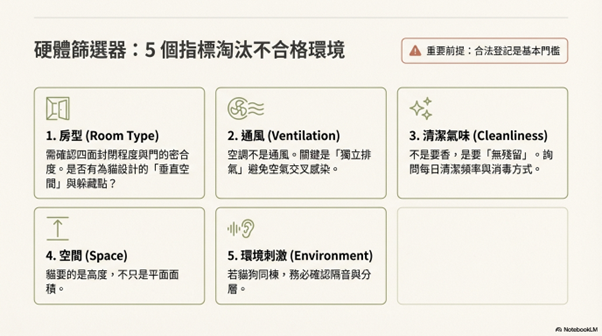
1) Room type: private vs. shared — can your cat truly be left undisturbed?
Many places advertise private rooms, but in reality they’re using dividers or semi-open enclosures. What you need to check is how fully enclosed the space is, how well the door seals, and whether the cat has somewhere to hide — as well as whether vertical space has been designed with cats in mind. Some review articles specifically note that rooms with vertical space are widely available and make a real difference in helping cats relax.
2) Cleanliness and odor management: not “smells nice” — “no lingering odors”
The biggest fear with cat hotels is a place that looks clean but has residual smells hanging in the air. Ask clearly about daily cleaning frequency, disinfection methods, and whether there’s a deep-clean schedule. Some hotels make “professional-grade cleaning and disinfection procedures” a selling point — which at least shows they understand what customers care about.
3) Ventilation and natural light: air conditioning isn’t ventilation — air extraction is what matters
Cats have sensitive respiratory systems, and cross-contamination of air between rooms is a high-risk factor. Look for “independent exhaust/ventilation” or designs that prevent air from circulating between rooms. Some cat hotels will explicitly state they have an “independent ventilation system that extracts stale air 24 hours a day.”
4) Video check-ins and update frequency
Some places offer live camera feeds; others send updates at scheduled times. The difference lies in whether updates include information on “eating, drinking, bathroom habits, and overall alertness” — and whether they proactively reach out when something seems off. A cat that hasn’t eaten for a day can be in serious trouble, so update frequency is not a minor detail.
5) 24-hour staffing, nighttime room checks, and double-door security
Many places advertise 24H, but it might mean “24H surveillance cameras,” not “staff on-site 24H.” Ask directly: is someone there overnight? How often are room checks done? What’s the procedure for detecting and responding to issues? Cats are escape artists, so ideally the layout between the main entrance and the boarding area should include a double-door buffer.
6) Activity space and vertical layout: cats need height, not just floor space
The same square footage looks very different with or without climbing platforms, elevated areas, and hiding spots. Some cat-only hotels emphasize “high-ceiling vertical spaces and cat-specific movement paths” — these descriptions are usually a good sign of a cat-friendly design.
7) Age/cat separation and soundproofing: can your cat see and smell less of other animals?
If cats and dogs share the same building, pay close attention to floor separation and soundproofing. Cats are easily startled by barking, and poor soundproofing can cause stress and loss of appetite.
8) Location and transport: convenience is a bonus, but don’t let it override safety
A pick-up and drop-off service is great, but your goal is to keep your cat safe and settled — not to save 15 minutes of driving time. Be clear about that priority.
9) Contract terms and cancellation policy (easiest to overlook, most likely to cause disputes)
Always review the house rules, surcharges (peak days, extra cats, cleaning, medication administration, late check-out), and cancellation terms beforehand — to avoid “assumed it was included, charged separately” surprises.
10) Health requirements before check-in (vaccines, deworming, chronic conditions)
Ask upfront which vaccines and deworming records are required and what the validity window is. For senior cats, cats with kidney disease, or cats that need medication, the question isn’t just “will you accept them?” — it’s “can you actually care for them properly?”: how is medication given, what indicators are monitored (appetite, water intake, litter box), and how often will you be updated if something seems off?
What is a “private cat room”?
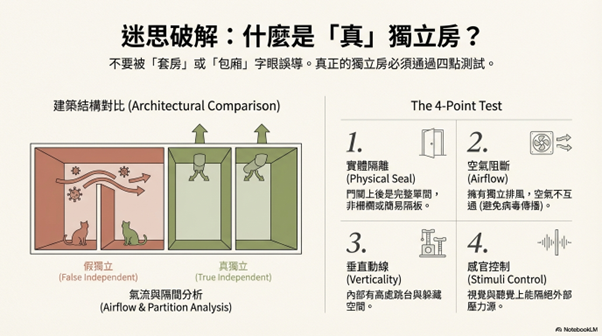
Terms like “private room,” “single room,” “suite,” and “open-plan” can be confusing for pet parents — but you can start by getting a handle on these concepts:
“Open-plan”
Multiple cats share a common space, sometimes with individual rest enclosures or partitions. The upside is more activity; the downside is high stress for shy cats, and increased risk if not managed carefully.
“Private room (single room)”
The basic idea is one room per household (or multiple cats from the same family in one room), so your cat doesn’t have to interact directly with unfamiliar cats — which helps reduce stress and cross-contamination.
- There are four things to check to tell whether it’s a “truly private room”:
- When the door is closed, is it a fully enclosed space (physical separation, not just a fence)?
- Does it share air circulation with other rooms? (Many people only look at the partition and overlook airflow cross-contamination.)
- Are there hiding spots and vertical space? (Cats need height and cover to decompress.)
- Can noise and visual stimulation be controlled? (Shy cats can easily stop eating when overwhelmed by continuous stimulation.)
Facility-based, home-based, or in-home sitter: which should you choose?
Cats are generally sensitive to environmental changes, so your cat’s personality is the most important factor to consider.
| Option | Best suited for | Advantages | Risks / blind spots | Questions to ask |
| Cat hotel (facility) |
Cats with good adaptability, or owners who want a standardized process | Standardized facilities, may offer cameras and scheduled updates | May be unstaffed at night, higher environmental stimulation | Nighttime room checks? Truly private rooms? Emergency medical SOP? |
| Home-based boarding (sitter’s home) | Cats okay with a new environment, but dislike the feel of cage-based stays | Home-like atmosphere, often cage-free, high interaction | Quality varies widely, limited spots (fully booked on long weekends) | Are there other animals in the home? Can they be separated? How often are updates sent? |
| In-home pet sitter | Shy, sensitive, or senior cats; multi-pet households | Cat stays in a familiar environment with minimal stress; ideal for cats that hate going out | Sitter must be trustworthy; process and safeguards need to be solid | Identity verification and review system? Payment protection? How are issues handled? |
- If your cat is shy, tends to hide, or stops eating in a new environment — prioritize an in-home sitter.
- If your cat is curious, adaptable, and enjoys interaction — home-based boarding or a facility-style hotel are both worth comparing.
- If your cat is a senior, has a chronic condition, or needs medication — focus first on the caregiver’s medical response SOP and update capabilities; the type of accommodation is secondary.
Common cat hotel fees and additional charges
The cost of a cat hotel is rarely just “price per night” — it’s typically a combination of a base room rate plus add-on charges.
As a general market reference: standard room/enclosure-style boarding tends to run around NT$500–$800 per night; deluxe or private room options may range from NT$1,000–$1,800.
Common add-on charges typically fall into a few categories:
- The first is “peak days and holidays.” Surcharges during Lunar New Year and long weekends are very common, and some places require a minimum stay or deposit during these periods (ask about the cancellation policy upfront so you don’t lose money on a last-minute change).
- The second is “additional cats.” A second or third cat sharing a room usually costs extra (or may hit a cap), so multi-pet households should always ask about the rules first.
- The third is “cleaning and problem behaviors.” Cats that spray, vomit, or require more frequent cleaning are often charged a cleaning or extra-care fee. Home-based and in-home options tend to be more flexible in these situations.
- The fourth is “specific update requests and medication administration.” Giving medication, wound care, or requesting more frequent updates are services many places charge extra for.
Pre-check-in requirements and health checklist for cats
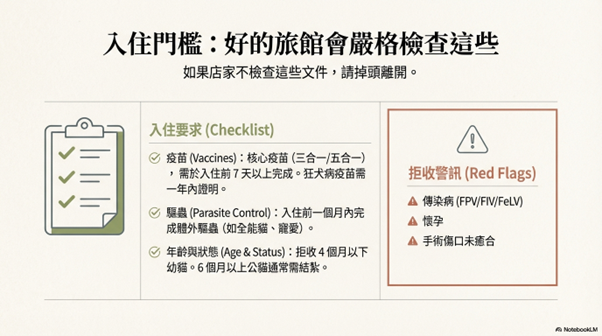
To protect the health of all boarded pets, reputable and licensed cat hotels maintain strict check-in requirements. These aren’t just rules — they’re an important indicator of the hotel’s overall quality. If a hotel doesn’t check vaccination records at all, avoid it.
Required documents and qualifications
Vaccination records:
- Core vaccines (3-in-1 / 5-in-1): Must be administered at least 7 days before check-in and within the past year. This is the basic protection against feline panleukopenia and feline herpesvirus.
- Rabies vaccine: Required by law in Taiwan; proof of vaccination within the past year or a valid tag must be presented.
Internal and external parasite treatment records:
- Proof that external parasite treatment (such as Broadline, Revolution, or Frontline) was applied within one month before check-in. Some hotels will impose mandatory isolation and charge a high flea-treatment fee if fleas are found during check-in.
Spay/neuter and heat cycle rules:
- Male cats 6 months or older are typically required to be neutered, to prevent urine spraying and heat-related vocalizations that disturb other guests.
- Female cats in heat are usually refused, or accepted with an additional cleaning fee and restricted to a designated area.
Age restrictions:
- Kittens: Those under 3–4 months (who haven’t completed their vaccine series) are typically refused due to extremely low immunity.
- Senior cats: Cats aged 12–15 years and above may be required to provide a recent health check report or sign a liability waiver to clarify responsibility in the event of a sudden illness.
Situations that may result in refusal (red flags)
- Cats with highly contagious diseases (such as FPV, FIV, FeLV, or FCV).
- Post-surgery wounds that have not healed within 7 days.
- Pregnant or nursing female cats.
- Cats with severe aggression that makes them unsafe to handle (some hotels may accept them in specific room types or without free-roam time).
Cat boarding prep checklist
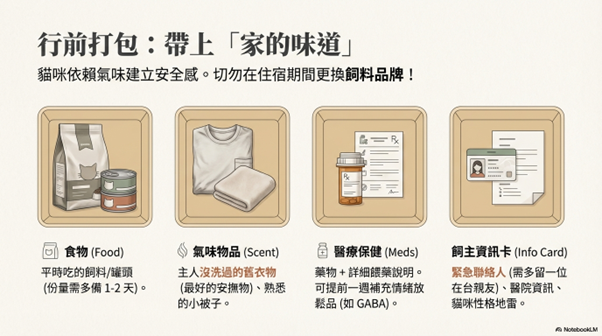
Cats rely heavily on scent to feel safe. When entering an unfamiliar environment, bringing items that smell like “home” can significantly reduce anxiety.
What to bring
Food:
- Their regular dry food or wet food: Portion out by day, plus 1–2 extra servings as a buffer. Do not switch to a new brand during the boarding period, as stress combined with a food change can cause serious digestive upset.
- Treats: Useful for rewarding, encouraging eating, or helping the sitter build rapport with your cat.
Medical and health supplies:
- Medications: If your cat has a chronic condition, bring the full course of medication with detailed administration instructions (dosage, timing, and method).
- Supplements: Lysine (to support immunity), probiotics (for digestive health), and calming supplements (such as GABA or tryptophan) can be started a week in advance.
Comfort and scent items:
- An unwashed item of your clothing: Don’t wash it — a T-shirt carrying your scent is the best comfort object you can bring.
- A familiar blanket or sleeping mat.
- A favorite toy: A wand toy or scratching pad.
Daily essentials:
- Cat litter: If your cat is particular about their litter, it’s strongly recommended to bring a small amount of their used litter to mix into the hotel’s fresh litter — it helps establish a sense of familiarity.
- Litter box: Some hotels allow you to bring your cat’s own familiar litter box.
Owner information card (emergency info)
- Emergency contact: In addition to yourself, provide the contact details of at least one person in Taiwan who can make decisions in case of an emergency.
- Your regular vet clinic: Include the clinic name, phone number, and your cat’s primary vet.
- A cat personality card: Note your cat’s preferences (likes head scratches, dislikes being held), sensitive spots (bites if belly is touched), and eating habits (prefers dry and wet food separate, or mixed).
Recommended cat hotels across Taiwan: Taipei, New Taipei, Taoyuan, Taichung, Kaohsiung
The following recommendations are based on a rigorous selection process factoring in online reputation (PTT/Dcard), Google reviews, facility standards (independent ventilation, medical-grade disinfection), and legal compliance (licensed exotic pet business registration).
Taipei cat hotel recommendations
As the most competitive market in Taiwan, Taipei’s cat hotels are characterized by a focus on refinement and technology.
| Hotel name | Area | Room highlights | Price guide (per night) | Why we recommend it |
| Apt. Meow (有毛公寓) | Songshan District | Scenic mid-size room | From NT$750 | Bright and airy: Large floor-to-ceiling windows with plenty of sunlight — not enclosed cabinetry. Features a curated cat goods shop on-site. Great atmosphere, ideal for cats that love basking in the sun. |
| Cat Hotel Catagoria (貓格里拉) | Da’an District | High-rise view room | From NT$800 | Medical-grade care: Located on a high floor with open views. Emphasizes a vet-backed medical transfer protocol, and is especially attentive to senior cat care. |
| Nordic Pet Hotel (北歐寵物旅館) | Da’an / Songshan | Open social space | From NT$840 | Special needs: One of Taipei’s best-known cage-free options, suitable for highly socialized, outgoing cats and dogs (subject to assessment). Includes a swimming pool facility. |
| Cat Garden (貓後苑) | Banqiao / Taipei | Smart private room | From NT$700 | Tech-driven management: Uses an AI-powered online booking system. Each room has independent ventilation and a water purifier. Multiple litter choices available to ease adaptation. |
| Fluv in-home sitter — Six Cats and Me (六毛與我) | Xinyi District | In-home care | From NT$650 | 30 years of experience: Supports medical care including administering oral medication, eye drops, and topical treatments. Provides customized in-home visits, walks, and photo/video updates — giving owners total peace of mind. |
New Taipei cat hotel recommendations
With more space to work with, many New Taipei hotels can offer more generous private rooms than their Taipei counterparts.
| Hotel name | Area | Room highlights | Price guide (per night) | Why we recommend it |
| Cat Forest (貓森旅) | Xinzhuang District | Cat-only standalone building | From NT$950 | Top choice for cat-only stays: The entire building is purpose-built for cats — no barking stress. Each room has a medical-grade air purifier and vertical climbing platforms. 24-hour monitoring via app. |
| The Cat Inn (私房貓旅) | Sanchong District | 7-star facilities | From NT$800 | Premium hardware: Equipped with a heat-exchange ventilation unit and infrared night-vision cameras. Offers dedicated storage for raw or fresh food — ideal for discerning households. |
| Good Times Pet Hotel (好時光寵物旅館) | Yonghe District | Comfortable partitioned rooms | From NT$700 | Excellent reputation: Combines grooming and boarding services. Consistently clean environment, attentive staff interaction — a popular choice in the Yonghe area. |
| Fluv partner hotel — Duo Mao Mao (朵貓貓) | Banqiao District | Private cat room | From NT$700 | Great value: Fully enclosed private suites with no free-roam mixing (prevents conflicts). Second cat in the same room at half price! Mid-to-high tier rooms include live video calls, and three litter types are available. |
| Fluv in-home sitter — Wu Xiao Ai (吳小愛) | Zhonghe District | In-home care | From NT$400 | Full-service sitter covering both Taipei and New Taipei, specializing in separation anxiety care. Provides full video updates and treat-based interaction throughout every visit. |
Taoyuan cat hotel recommendations
Thanks to its proximity to the airport, Taoyuan has developed a number of distinctive hotels that combine airport transfer services with longer-term boarding.
| Hotel name | Area | Room highlights | Price guide (per night) | Why we recommend it |
| Hi! Pets Terminal (嗨!寵物們航站) | Airport / Dayuan | On-site at the airport | Enquire for pricing | Most convenient for travelers: Located directly in Terminal 2 of Taoyuan Airport — easy drop-off before departure. High-grade air purification and dehumidification equipment; ideal for frequent travelers. |
| Curly Uncle (捲毛叔叔) | Zhongli District | Strict floor separation | From NT$700 | Safety first: Dogs and cats on entirely separate floors with no cross-interaction. 24-hour remote monitoring. Unique “do not disturb” service for cats to minimize environmental stress. |
| Sunlight Cat Villa (日光貓寓) | Zhongli District | Home-like room design | Enquire for pricing | Spacious rooms: Emphasizes room-like spaces rather than basic enclosures — each room comes with ample vertical climbing structures. |
| Fluv in-home sitter — Qianqian (蒨蒨) | Taoyuan | In-home care | From NT$400 | Veterinary assistant background, specializing in senior and dementia pet care. Holds 5 years of grooming experience and 4 years as a sitter, with prior work at a veterinary clinic and an animal foster program. Particularly skilled at caring for senior and cognitively declining pets. |
Taichung cat hotel recommendations
Taichung hotels are known for their “luxury residence” standard — spacious, beautifully designed, and relatively affordable.
| Hotel name | Area | Room highlights | Price guide (per night) | Why we recommend it |
| Mùmao Boutique Pet Hotel (牧貓精品寵物旅館) | Xitun / South District | Presidential suite | From NT$680 | Ultimate luxury: Features a rarely-seen “presidential room” and a huge indoor activity area. Strictly follows medical-grade disinfection protocols; well-suited for multi-pet households. |
| TaTa Cat Hotel (踏踏貓旅館) | Nantun District | Villa-style rooms | From NT$790 | Well-rounded facilities: Full range from standard to villa-style rooms to suit different budgets. Professional grooming services and multiple litter choices available. |
| Black Nose Pet Hotel (黑鼻子寵物旅館) | Xitun District | Independent suite | From NT$650 | Professional care: Adopts a Swiss-standard care system; every room has its own air conditioning unit, effectively reducing odor and bacterial transmission. |
| Fluv in-home sitter — Ichimokezaki 𝑲𝒂𝒛𝒖𝒌𝒊🕊 (一木毛宅) | North District | In-home care | From NT$500 | Emergency/exotic animal medical background: competitive-level grooming specialist with 10 years of experience (Taichung/Taipei), former veterinary emergency and exotic animal assistant. A top-tier sitter with genuine medical care capabilities. |
Tainan cat hotel recommendations
Infused with the character of an ancient city, Tainan’s cat hotels are often converted from townhouses or historic buildings — full of creativity and warmth.
| Hotel name | Area | Room highlights | Price guide (per night) | Why we recommend it |
| Cat House Forever (貓宅一生) | South District | Large-footprint rooms | From NT$400 | Exceptional value: Each room is roughly one ping (about 3.3 m²) in size, yet priced very affordably. Daily photo updates sent in abundance — perfect for budget-conscious owners and longer stays. |
| Susisusi Cat Hotel (四序貓旅) | Yonghe District | Cat-exclusive stay | Enquire for pricing | Quiet and discreet: Emphasizes privacy and a home-like, stress-reducing atmosphere with minimal outside interference — ideal for anxious or high-strung cats. |
| MoDi (毛邸) | West-Central District | Renovated heritage building | From NT$1,200 | For the design-minded: Combines a pet-friendly café with boarding accommodations. VIP suites include a private terrace — a truly unique and atmospheric stay. |
| Fluv in-home sitter — Xiaohui (小慧) | West-Central District | In-home care | From NT$400 | Currently working as a veterinary assistant, holding a PCP (Specific Pet Care Professional) certification. Brings hands-on clinical experience to every visit, offering a level of medical confidence that’s hard to match. |
Kaohsiung cat hotel recommendations
Kaohsiung offers affordable boarding rates, and most options include basic free-roam time and interactive care as standard.
| Hotel name | Area | Room highlights | Price guide (per night) | Why we recommend it |
| NiuNiu Cat House (扭扭貓屋) | Zuoying District | Diverse room types | From NT$500 | Convenient location: Room options range from budget-friendly cabins to deluxe view rooms. Close to Zuoying HSR Station, making drop-off easy. Well-reviewed. |
| Xixi Cat Hotel (希希貓旅) | Fengshan District | Warm and quality environment | Enquire for pricing | Senior cat-friendly: Focused on senior cat care. Calm and cozy environment with soft background music to help cats relax. Attentive, detail-oriented staff. |
| Duo Ye Le Hotel (多野樂旅館) | Nanzi District | Resort-style complex | NT$4,000+ | Owner and pet together: A whole-building resort combining pet grooming and a pool — perfect for owners who want to vacation with their pets and enjoy a luxury experience together. |
| Fluv in-home sitter — Lots of Fur, 24H Home Boarding (毛很多犬貓優質居家保姆24H) | Nanzi District | In-home boarding | From NT$600 | 24-hour hands-on care: A step above hotels that have no one on-site at night — provides round-the-clock companionship and basic grooming. Your pet is never left alone (a backup plan and camera monitoring are always in place when out), directly addressing the nighttime safety concern that comes with most pet hotels. |
Frequently asked questions about cat hotels
Q1: How do I make sense of pricing without getting caught off guard by surcharges?
Start by getting the base room rate, then ask about peak/holiday surcharges, and finally ask about the easy-to-overlook extras like cleaning fees, medication administration, and specific update requests. The price gap between room types is usually bigger than you’d expect — especially once you move from open-plan to private rooms to deluxe suites.
Q2: What should I look for in a private cat room?
Don’t just ask “is there a divider?” Check four things: is it a fully enclosed space (physical separation), does it share airflow with other rooms, how well is soundproofing and sensory stimulation controlled, and does it have hiding spots and vertical movement options?
Q3: What does “24H” actually mean?
At many places, “24H” means surveillance cameras, not a person on-site. Ask directly: is someone there overnight, how often are room checks done, and what’s the protocol when something goes wrong? The more specific and concrete the answers, the more trustworthy the place.
Q4: How do I evaluate home-based vs. in-home sitter options?
Shy, sensitive, or senior cats should have in-home sitting as the first option. If your cat is adaptable and you’d like someone around all day, home-based boarding or a facility hotel are both worth considering.
If your cat stops eating every time it’s in a new environment, in-home sitting is almost always the least stressful choice.
If your cat is shy, an in-home cat sitter is often a better fit than a cat hotel
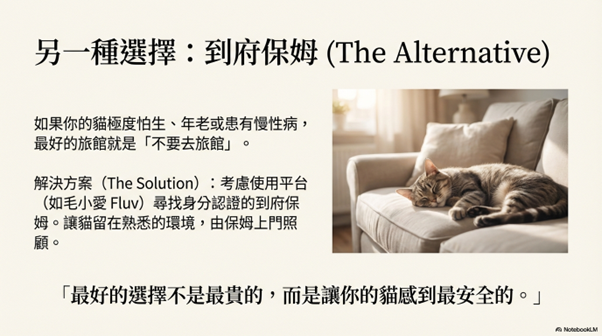
After going through all the criteria above, there’s one reality that should be clear: not every cat is suited for boarding outside the home. Some cats will feel stressed no matter how luxurious the room, simply because of unfamiliar smells and a change in surroundings. In those cases, rather than searching for “the cat hotel that looks most like a resort,” it makes more sense to remove the environmental variable entirely — let your cat stay at home, with a pet sitter coming in to care for them.
This is exactly what Fluv is built around: the platform offers in-home boarding and in-home pet sitting services with transparent pricing and process, online card payment, and third-party escrow — the sitter only receives payment after the owner confirms the service was completed satisfactorily. Importantly, Fluv states that its service fee includes Cathay Pet Insurance and a service quality guarantee. According to their FAQ, if you’re unsatisfied with the service, a full refund is available (or up to a full refund).
Fluv exclusive offers | Limited-time deals for pet lovers
#Give your pet the best — and that means what fits them best
If you’d like a more personalized, home-like care experience for your pet, why not try Fluv’s home sitter service?
🎁 New members: enter promo code
#UNEW95
Book now and enjoy a 5% discount!
👉 Ready to find a caring, professional pet sitter for your furry family member?
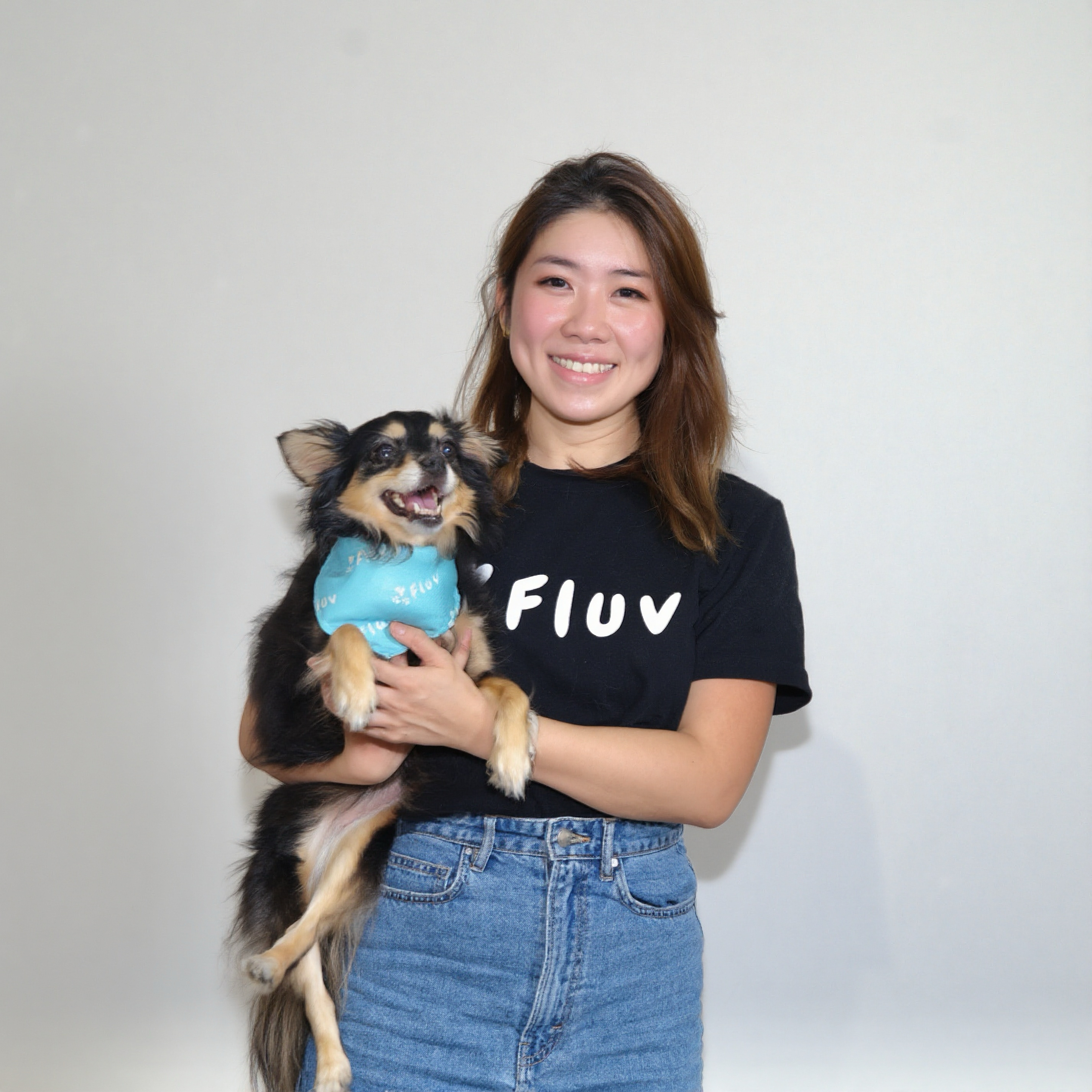
Fluv founder Candace Chen
Forbes 30 Under 30 Asia | 2024 Tatler Gen.T Leaders of Tomorrow
As the founder of Fluv, Candace has combined exceptional business vision with execution to build the most trusted and widely used pet care platform in Taiwan.
- World-class recognition: Named to Forbes 30 Under 30 Asia and selected as a 2024 Tatler Gen.T Leader of Tomorrow.
- Backed by major investors: Has secured investment from Twitch co-founder Kevin Lin and influential venture capital firm SIC.
- Market leader: Has grown Fluv to a community of over 7,000 vetted professional sitters, trusted by 140,000 members.
Further reading: 2026 pet hotel pricing explained: how much does it cost per day? Cat and dog boarding fees vs. sitter rates compared
Views: 2081
 English
  Chinese